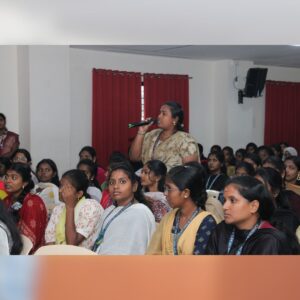
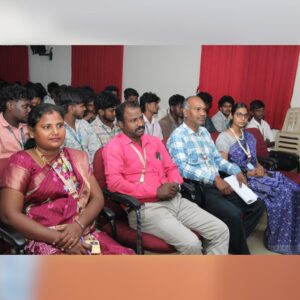
Department of Corporate Secretaryship, in collaboration with the Kerala Economic Association, organized a Mentorship Session on 24.02.2026
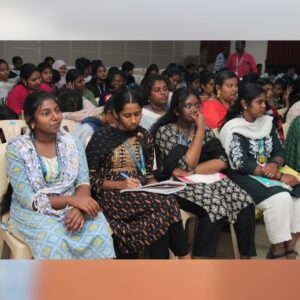
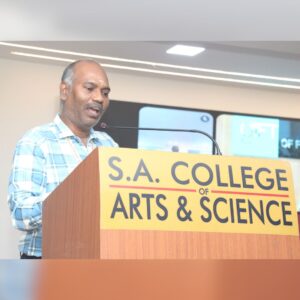
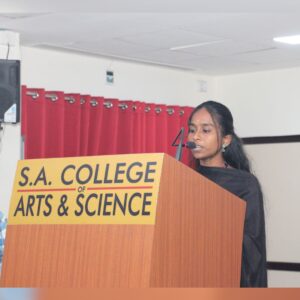
Mentorship Session on a Comprehensive Overview of the Union Budget 2026–27 On 24th February 2026, the Corporate Governance Professionals’ Association, under the aegis of the Department of Corporate Secretaryship, in collaboration with the Kerala Economic Association, organized a Mentorship Session on the topic “A Comprehensive Overview of the Union Budget 2026–27.” The session was delivered by Dr. Aswathy Rachel Varughese, Assistant Professor of Economics at the Gulati Institute of Finance and Taxation. Her research focuses on Macroeconomics, Development Economics, and Applied Econometrics, and she has published in reputed SSCI- and Scopus-indexed journals. The session was attended by 127 students. The programme was compered by Ms. Shabreen and Ms. Shalini, Assistant Public Relations Secretary. The welcome address was delivered by Ms. Nethra, Assistant Student Director. Ms. Vani, Assistant Joint Secretary, formally introduced the Chief Guest. Mr. V. Sivaprakasam delivered a brief summary of the event. The vote of thanks was proposed by Ms. Shajida, Social Media Secretary.
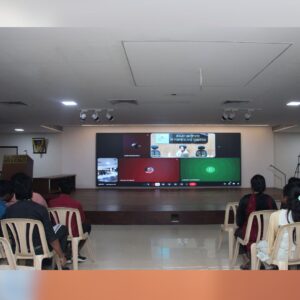
Dr. Aswathy Rachel Varughese, delivered an interactive, insightful, and highly valuable presentation in online mode. She began by mentioning that February is known as the month of the Union Budget, and it is the duty of every citizen to understand it. However, many people do not know how to read or interpret the Budget, and she emphasized that her session aimed to address this gap. She also expressed her gratitude to the organizers for arranging such an informative event. She started with an overview of her presentation, which covered the basic approach to understanding the Budget and the different categories within it. The first slide focused on macroeconomics what the macroeconomy is, why it is important, and how geopolitical factors influence it. She explained that the government is deeply concerned about controlling tariffs and reducing excessive dependence on imports. A major focus of this year’s Budget, she noted, is promoting self-reliance in key sectors. Moving on to the numerical aspects, she described the Budget as the backbone of a country. While reading the Budget, special attention must be given to the gap between revenue and expenditure. The size of the national Budget refers to the total expenditure proposed for the financial year, and it is usually presented in lakh crore or trillion rupees. She explained that government revenue is broadly classified into tax revenue and non-tax revenue. Tax revenue is further divided into direct taxes (such as income tax and corporate tax) and indirect taxes (such as GST and customs duties). Apart from these, there are capital receipts, which include borrowings and loan recoveries. Borrowings are categorized as debt-creating liabilities, whereas loan recoveries and certain other receipts are considered non-debt capital receipts. On the expenditure side, there are two major categories: revenue expenditure and capital expenditure.
Revenue expenditure includes the amount spent on running the government, administrative expenses, interest payments, and subsidies. Capital expenditure refers to money spent on building infrastructure and creating long-term assets. The gap between total revenue and total expenditure is referred to as the fiscal deficit. To bridge this gap, the government resorts to market borrowings. The fiscal deficit for the current year is estimated at ₹15.6 trillion, which is about 4.3% of the country’s GDP. GDP (Gross Domestic Product) represents the overall size and health of the economy. A manageable fiscal deficit helps maintain investor confidence, whereas an excessively high deficit can discourage investment. Under the broader concept of deficit, there are three main types: revenue deficit, fiscal deficit, and primary deficit. She clarified that gross tax revenue refers to the total tax collected from all sources, while net tax revenue is the amount retained by the central government after sharing with states. She noted that direct tax collections have increased in the current year. However, tax buoyancy the responsiveness of tax revenue growth to GDP growth has been declining in recent years, indicating the need for careful fiscal management. Non-debt receipts include funds received from sources such as dividends and surplus transfers from the Reserve Bank of India (RBI). She also explained trends in government spending. A major driving factor behind revenue expenditure is interest payments and subsidies. While interest payments have been rising due to higher borrowings, subsidies had increased significantly during the COVID-19 pandemic and have gradually reduced afterward. Providing subsidies, she emphasized, is part of the government’s social responsibility. The total capital expenditure has been significantly increased, amounting to approximately ₹12.2 lakh crore, highlighting the government’s focus on infrastructure development and long-term growth. She also discussed the cost of redistribution and its impact on fiscal planning. Finally, she explained industry-centric initiatives, detailing how budget allocations are distributed across different sectors and how these expenditures are financed. She pointed out that employment elasticity the extent to which economic growth generates employment remains a missing or underemphasized aspect of the Budget. Overall, the session provided a comprehensive and practical understanding of how to read and analyse the Budget, making a complex subject accessible and engaging for the audience.